
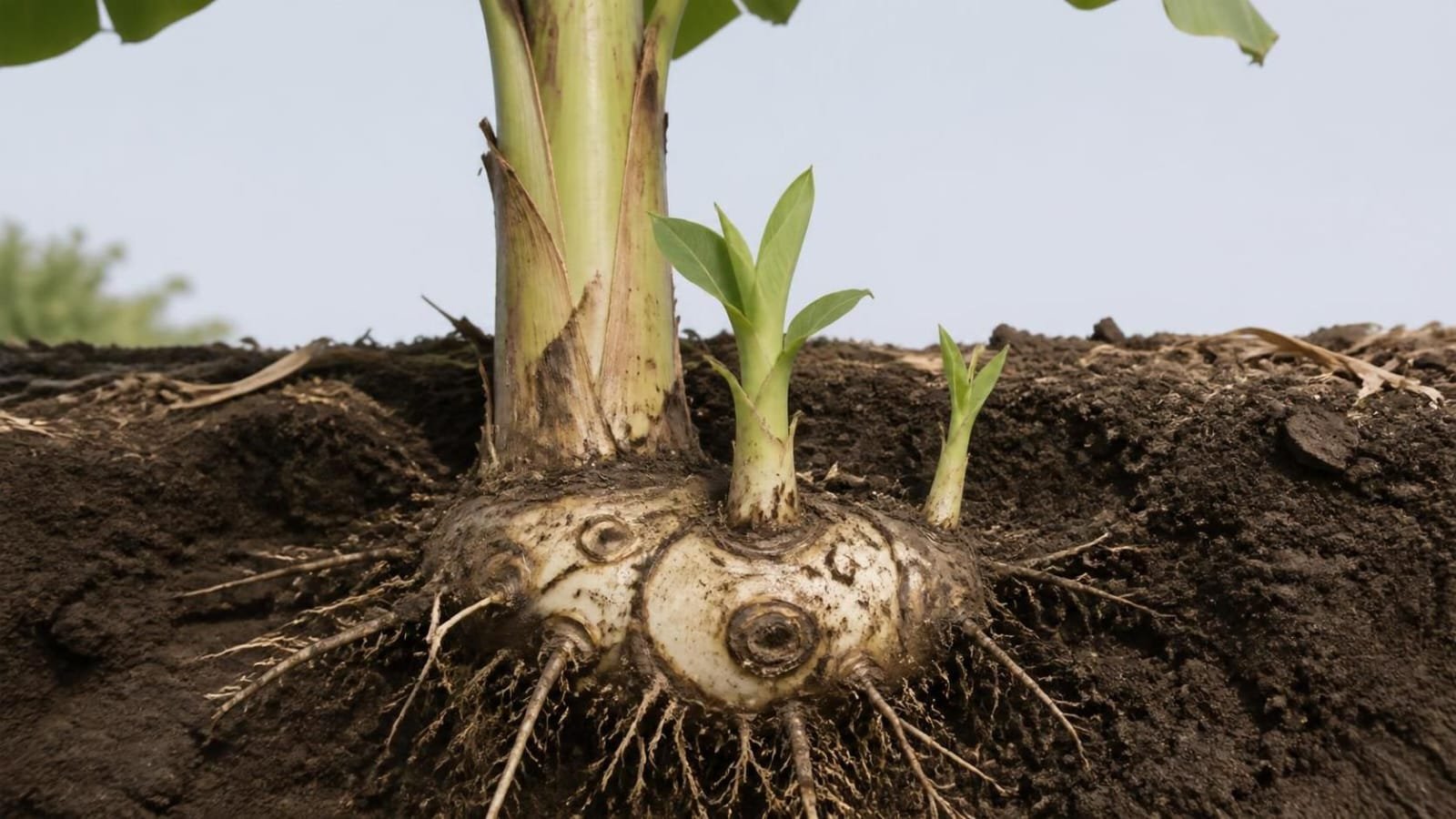
To propagate a banana plant, cut a young shoot (a sucker, or pup) away from the underground base of a healthy mature plant. Take some of its own roots with it. No pup? Plant a clean piece of that base that still has a bud. A banana “bulb” is really a corm, store-bought bananas have no seeds to sow, and a leaf cutting will not make a plant. Pick a pup with narrow, sword-shaped leaves, and check it for disease before it goes near your soil.
If you arrived by typing propagating banana trees, banana seedlings, banana rhizomes, or banana tree bulbs, you were circling one idea from several directions. Those terms don’t all mean the same thing, and some are far more useful than others when you’re looking for planting material.
Banana rhizomes, corms, and the “bulb” that isn’t one
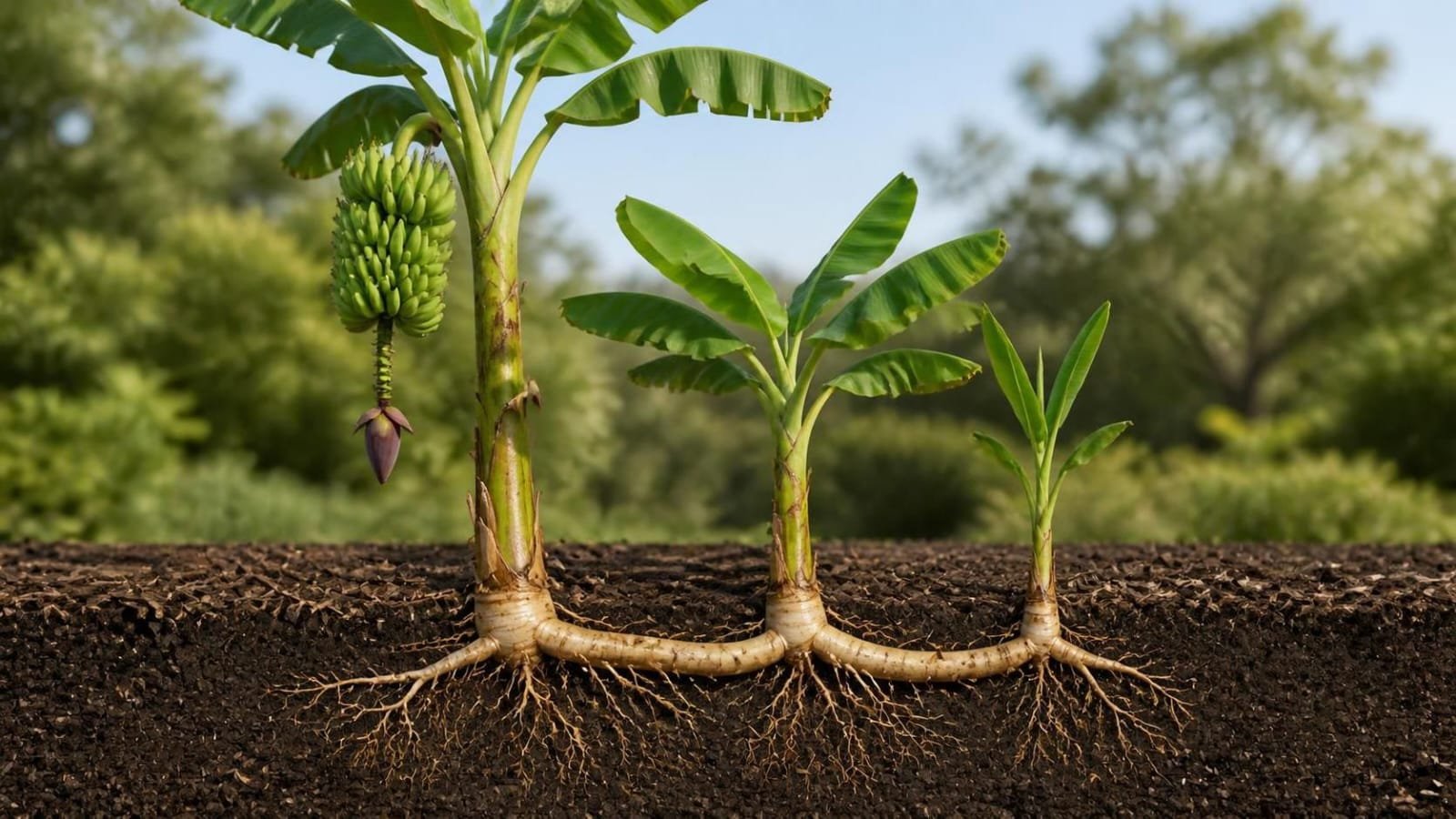
The thing that looks like a trunk is a stack of leaf sheaths wrapped around each other, called a pseudostem. It is temporary. The part that lasts is underground: a thick, short stem called a corm or a rhizome. Banana literature uses “corm” and “rhizome” for the same underground stem, and the University of Florida’s extension fact sheet even writes “rhizome (corm).” Buds sit along it, and some of them grow into suckers.
That is why “bulb” leads people astray. An onion or a tulip is built from layered, swollen leaves. A banana’s base is a stem, and it acts like one. You can dig it, cut it, and replant the pieces, as long as each piece keeps a bud. When a seller lists banana “bulbs,” ask whether you are getting a rooted pup or a bare corm section. They grow very differently, and the listing rarely says.
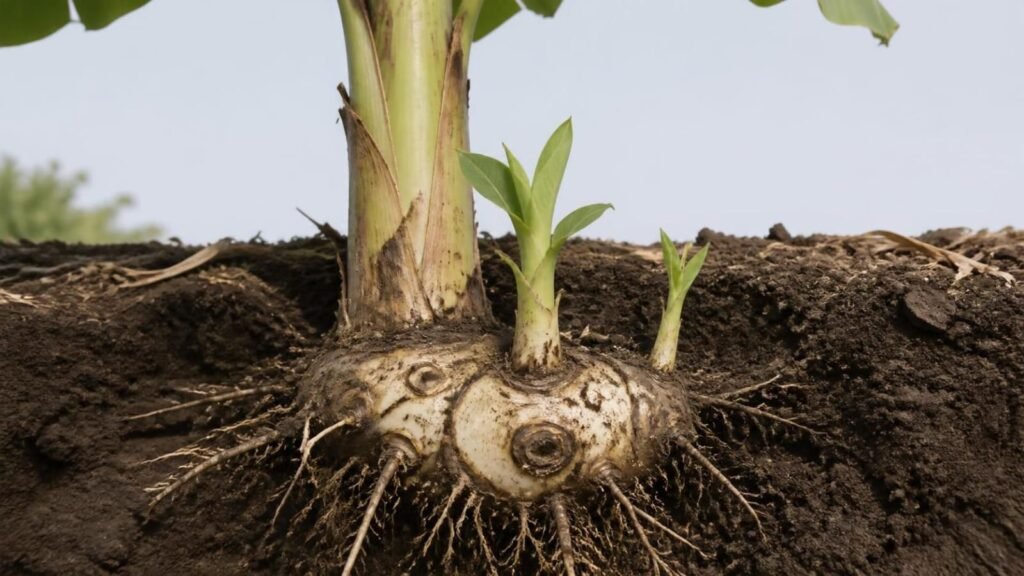
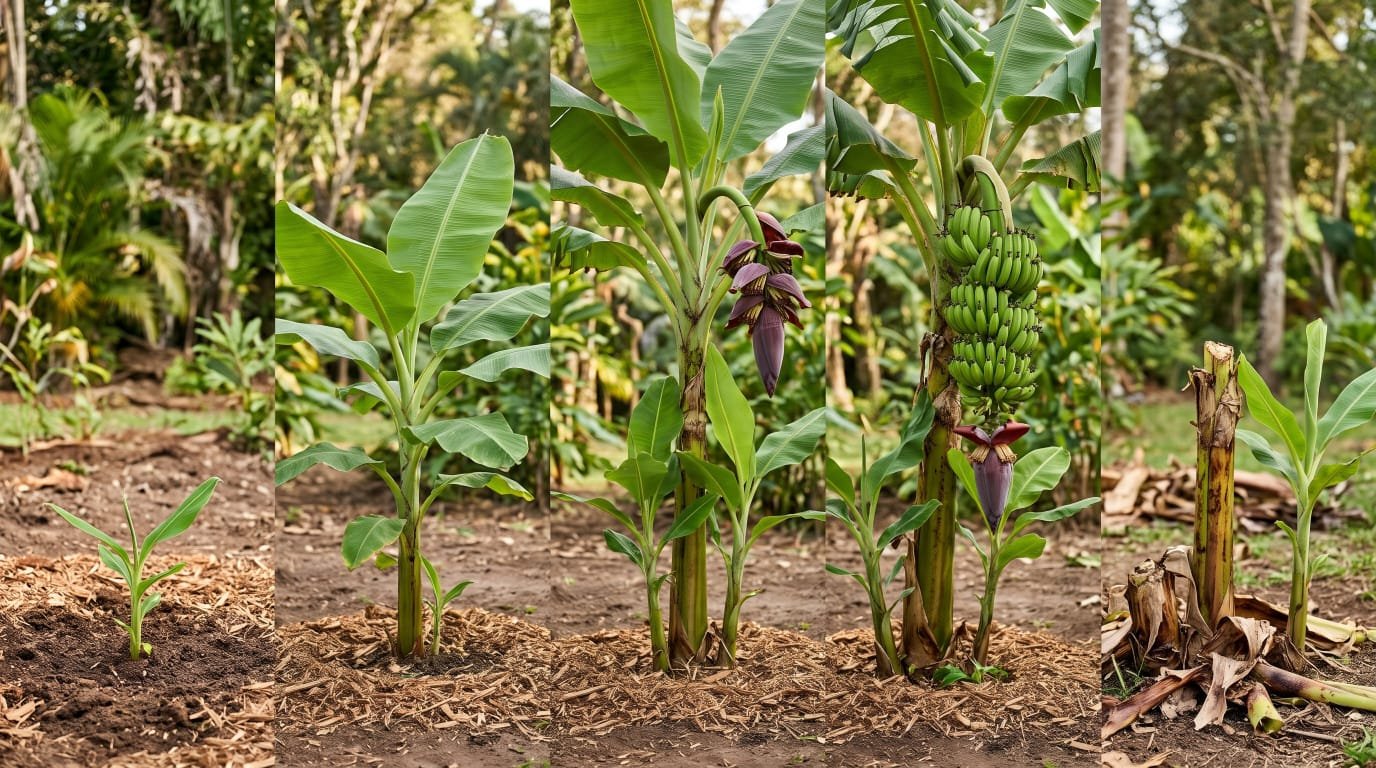
This base also explains why the plant never really dies. The stem that fruits does so once and is cut down, and the corm sends up the next one. If that part of the story is new to you, our guide to the banana tree life cycle and growth stages walks through it, and why banana trees only fruit once covers the stem that is lost after harvest.
Why “banana seedlings” is the wrong thing to chase
Most of us have hunted for seeds in a grocery-store banana at some point. Those little dark specks are what is left of seeds that never developed. Many familiar edible cultivars are triploid hybrids with three sets of chromosomes, and most are grown for fruit that swells without pollination, so there is nothing to sow. Their wild parents, Musa acuminata and Musa balbisiana, are the seedy ones.
Seeds are not useless, though, and that is where the confusion starts. The Royal Horticultural Society lists seed as a route for some species. That suits you if you want an unusual species and can wait. Ensete, a close relative sold as an ornamental, does not sucker at all, so seed is its only route. Even when an edible banana does set seed, it is a gamble. A report in the journal Botanical Studies described rare seeds from two edible triploid bananas growing beside wild diploids. The offspring were tetraploid hybrids, not copies of the mother.
So the choice is simple. Want the banana you have already eaten, or the one in your neighbor’s yard? Clone it with a pup or a corm piece. Want a surprise, or a wild species? Seed is fair game.
Choosing the pup: four kinds of sucker, one good choice
The first instinct is to grab whatever is closest to the mother plant. Hold off. Suckers come in different types, and the type decides whether you get a strong plant or a weak one.
| Sucker type | Verdict | What you will see | What it means |
|---|---|---|---|
| Peeper | Leave it | A very small shoot, about 1 to 12 inches, with leaf sheaths and no real blade yet. | It may become a sword or a water sucker, or stall. Leave it to declare itself. |
| Sword sucker | Best | Narrow, sword-like leaves on a cone-shaped stem. Broad leaves come late, often past about 3 feet. | Grows into a fruiting stem. The usual first choice. |
| Maiden sucker | Good | A large, leafy, non-fruiting stem with its own roots and some corm. | Preferred along with large sword suckers; also a source of corm pieces. |
| Water sucker | Weak | Broad, adult-looking leaves early, a small corm, and a weak attachment to the mother. | Extension advice says its fruit is inferior, and it is poorly suited to carry on as the next stem. |
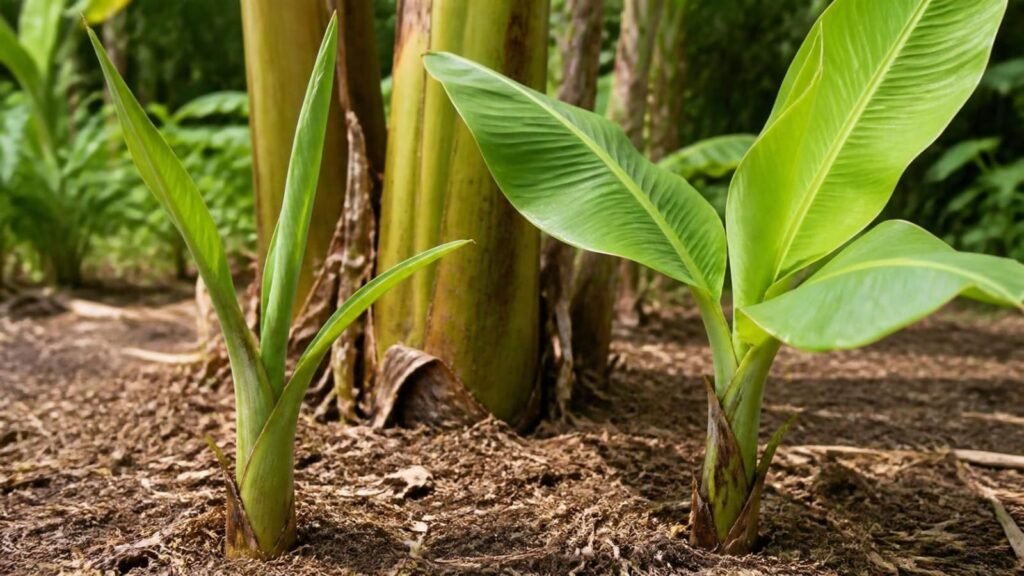
A word on that last row. Extension advice is against water suckers, and the ProMusa banana knowledge base says their attachment to the corm is often weak. Yet it also cites one comparison where sword and water suckers of equal height flowered together and gave similar bunches. So a water sucker is not doomed. It is a gamble, and you only need to take it when nothing better is on offer.
How big should it be?
Every page gives a different number, and the disagreement is real. One popular guide says 12 inches. Another says 3 feet or more with roots. A university extension sheet says to dig sword suckers at 4 to 5 feet. The FAO’s propagation protocol lands in the middle. It describes a typical sword sucker as 20 to 40 inches long, with a base at least about 5 inches (12 cm) across. Size is not everything, though. In the Brazilian trial covered below, small and large sword suckers both performed best. A modest pup is fine if it is a true sword type with roots.
Your goal settles it. For a fruiting banana in the ground, I would go with a sword pup of roughly 2 to 4 feet that has its own roots. More root and corm helps it get through transplant shock. For a potted ornamental you will never harvest, a smaller pup with several leaves works. Final height varies a lot by variety, so our guide to banana tree height and size will help you pick one that fits your space.
How to separate a banana pup from the mother plant
Most of us grab the pup and pull. It rarely comes clean. The roots are tangled with the mother’s, and pulling tears the very roots the new plant needs. Dig first.
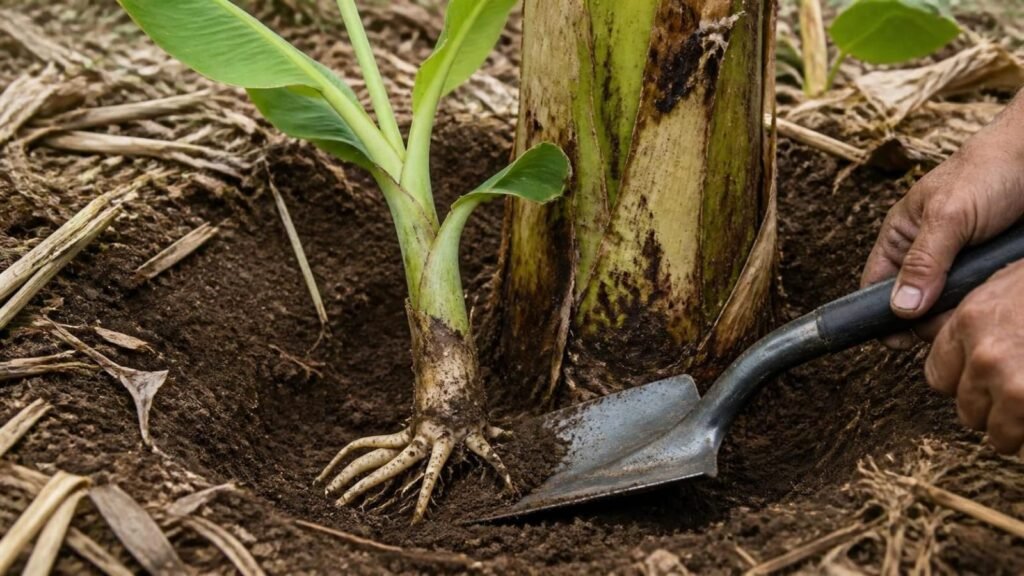
- Pick a pup growing a short way out from the mother, with narrow leaves. Scrape the soil back to confirm it has roots of its own.
- Water the clump the day before. That is habit, not research, but soft soil cuts cleaner.
- Expose the connection between the pup and the mother corm.
- Cut straight down between the two with a sharp, clean spade or blade. Keep as many of the pup’s roots as you can. Disinfect your tool before moving to another plant.
- Trim the largest leaves and keep the youngest, so the roots are not feeding more foliage than they can.
- Plant at the same depth the pup was growing, water it in well, and lay a heavy mulch around it.
Many growers let cut surfaces dry a day or two before planting to cut down on rot. It is common practice, but none of the sources I opened tested it.
- Do not strip the clump. Leave a good follower so the mother plant can keep cropping.
- Do not plant into soil that stays wet. Corms rot where drainage is poor.
- Do not take a rootless pup and expect it to carry on. Treat it as a corm piece and give it time.
No pup? Planting a piece of the corm
If the clump has not made a good sucker, or you have just dug up an old mat, you can cut up the corm itself. Extension guidance says to cut a large maiden sucker’s stem down to about 8 inches, then slice the corm into planting pieces. Each piece should hold only clean white tissue and a few buds. Trim off damaged roots and dark tissue before anything goes in the ground. Keep the pieces sizeable, at least about 5 inches across, which is the usual minimum for direct planting.
The trade-off is time. A Brazilian trial with the ‘Nanicão’ cultivar compared small and large sword suckers, water suckers, rhizome sections, and tissue culture. Rhizome sections gave similar results to the best material but took longer to reach the first harvest. Extension advice says the same: slower, with a smaller first bunch.
Tissue culture plants: cleaner, not automatically stronger
Tissue-culture plantlets are grown in a lab from a tiny piece of growing tip. They arrive uniform and free of nematodes and most diseases, and that is the real selling point. The drawbacks are cost, availability, and the nursery time a small plant needs before it is ready to sell. The FAO also warns that off-types (somaclonal variants) can turn up. It advises against tissue culture for plantains and other AAB types, because a virus hidden in their genome can wake up in the lab.
The Brazilian ‘Nanicão’ study is a useful reality check. Its tissue-culture plants gave the lowest bunch weight, the longest first cycle, and a high rate of variation. One cultivar and one trial prove nothing universal. The narrow lesson still holds: you buy tissue culture for health and uniformity, not speed. Buy from a licensed nursery that can tell you where the plants came from.
The disease check nobody mentions at the nursery bench
Whatever the mother carries, the pup carries. Panama disease (Fusarium wilt), banana bunchy top virus, other viruses, nematodes, and banana weevils all travel on planting material. Here’s the catch: a pup from an infected mat can look perfectly healthy, so looks alone prove very little. There is no chemical cure for Panama disease, either. The only real controls are land free of the fungus, clean planting material, and resistant varieties.
So check what you can see. Look over the pup’s roots for lesions or swellings. Pare the corm. It should be a uniform creamy white, and if dark tunnels or discolored patches take up a quarter to a third of it, throw it out. Then cut the pseudostem about 4 to 6 inches above the corm and look at the cross-section. Off-colored rings, liquid, or brown spots mean the pup goes in the trash. These checks cost nothing.
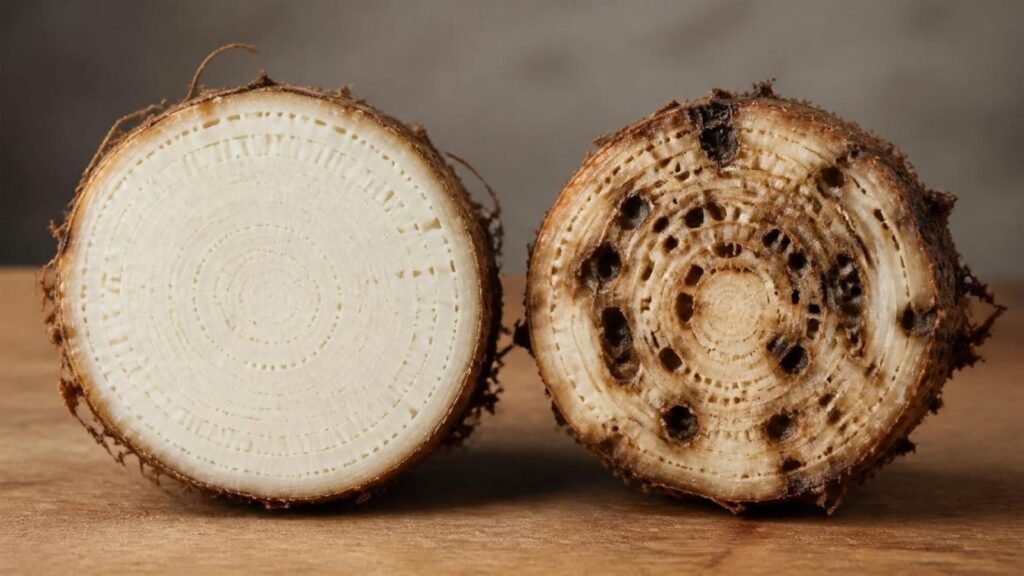
For bunchy top, look at the mother plant too. Hawaii’s extension service describes stiff, narrow, bunched leaves with yellow margins and dark streaks along the veins. Suckers from an infected plant will not make a bunch. Hawaii also asks people not to move banana corms, suckers, stems, or leaves out of affected areas. If you live somewhere with a quarantine, ask your state agriculture department before you move anything.
This is a sanitation treatment for planting material, not a routine home-gardening step. Commercial growers use a hot-water dip on pared suckers, with the roots trimmed off, to kill weevil eggs and nematodes: 20 to 30 seconds in boiling water, or 20 to 25 minutes at 50 °C. It does not cure Fusarium or viruses. Check with your county extension office before trying it at home.
One limit, stated plainly: you cannot confirm a virus or Fusarium from a photo or a description. If a clump looks wrong, your county extension office or state plant-health service can test it.
Planting, and the first few weeks
Plant when it is warm. In south Florida, March through May is best if you can irrigate. Otherwise, wait for the June rains. Banana growth slows below about 60 °F and stops near 50 °F, so a pup in cold soil just sits there. In colder states, pot it up indoors or in a greenhouse and move it out after frost danger has passed.
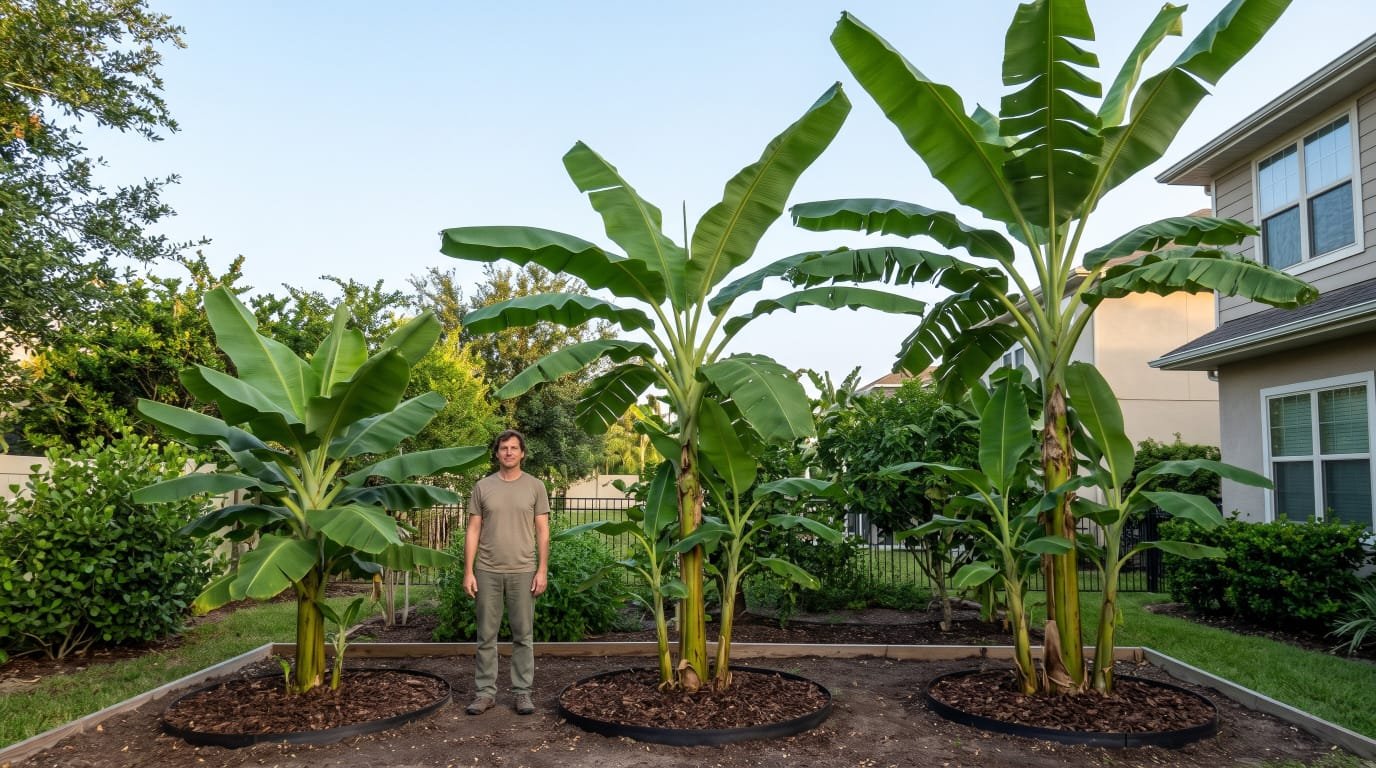
Give it room. Dwarf types can sit about 8 feet from other dwarfs, while large varieties need 12 feet or more. For a container, pick a pot just big enough for the roots, use a free-draining mix, and pot up as the plant grows.
Please don’t judge a pup on day three. A transplant often droops while the roots recover, and drowning it makes things worse. Check the soil before you reach for the watering can.
Can you grow bananas from a leaf, a glass of water, or a store-bought banana?
None of the standard methods starts from a leaf, so leaf cuttings are out, and a grocery-store banana has no viable seed to sow. Rooting a pup in water is a different story. One nursery blog suggests starting a pup with few roots in a glass of water, but I could not find a university or government protocol that does it. Until one turns up, plant into well-drained soil or mix and skip the glass.
How long until it fruits?
From a small sucker to harvest, the extension sheet gives 9 to 20 months, depending on temperature, variety, and care. The flower stalk usually shows up 10 to 15 months after planting. The fruit then needs another 80 to 180 days. Corm pieces run slower than rooted pups, with a smaller first bunch. We break those stages down in when banana trees flower and produce fruit and how long a banana tree takes to grow.
Before you cut anything, scrape the soil back from the pups and check three things: leaf shape, roots, and the color of the corm tissue. Get those right and the rest is just digging.
One thought on “Propagating Banana Plants: Suckers, Corms, and Myths”