
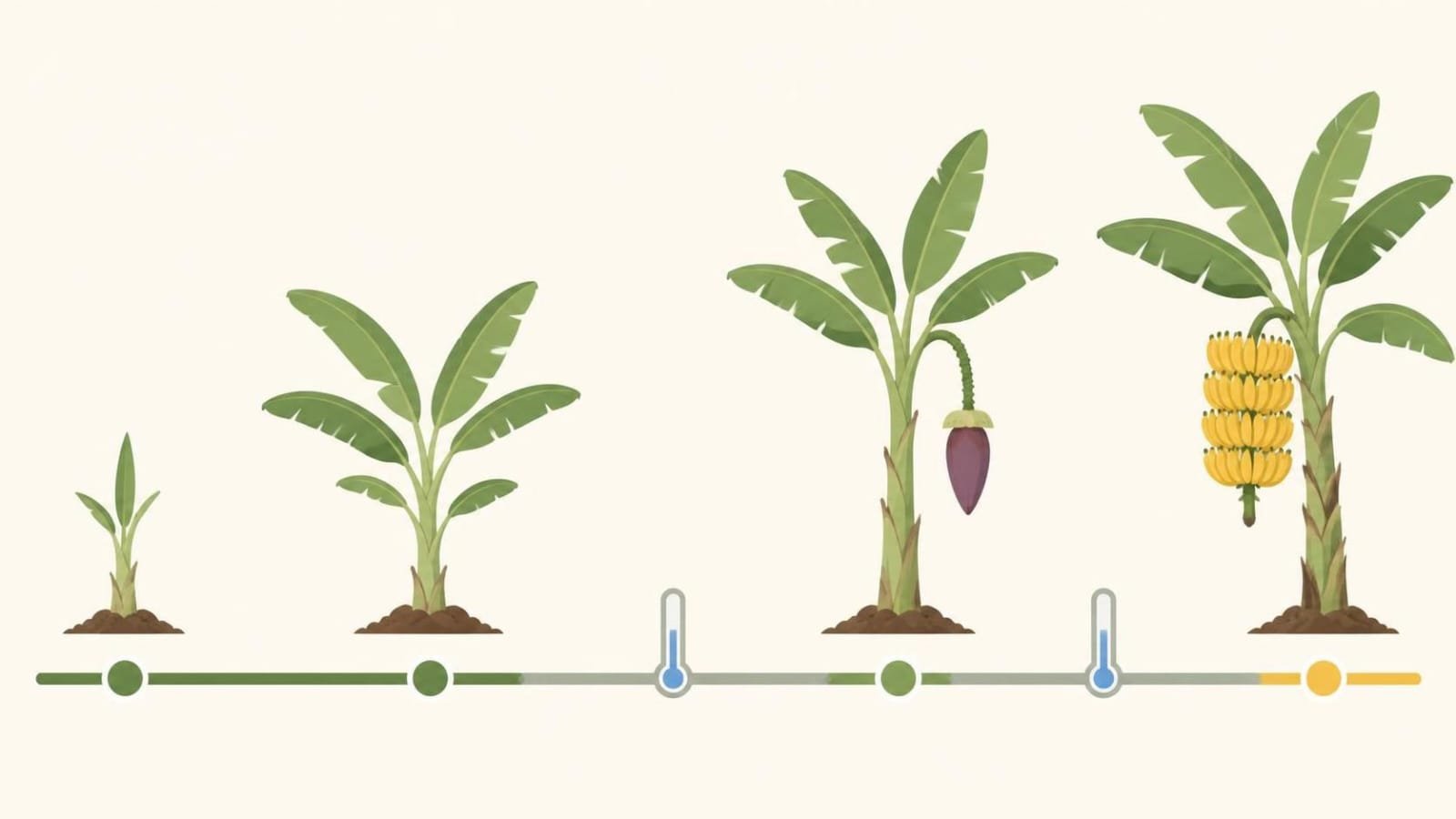
In a warm climate, a healthy sucker or nursery plant usually takes about 12 to 18 months to give its first ripe bunch. That is two waits added together: roughly 10 to 15 months for the flower stalk to appear, then 80 to 180 days for the fruit to fill. Cold nights, shade, dry spells and crowded stems stretch the first wait. The variety you planted changes both.
The quickest check on whether your own plant is keeping pace is the leaves. In warm weather a healthy banana opens a new leaf about every week to ten days. When that stops, so does the clock. Most of what follows is about finding out why it stopped, and how to tell a slow banana from a stalled one.
Banana Tree Growth Time: Two Clocks, One After the Other
A banana is not a tree. It is a giant herb, and for the first year or so it only builds. Roots go out first. Then leaf after leaf stacks up around the growing point, and the overlapping leaf stalks thicken into the pseudostem, the soft column that passes for a trunk. Nothing edible happens until the plant has made enough leaves. Extension specialists at the University of Florida and at Texas A&M both put that point at 10 to 15 months after a sucker is planted or first emerges. By then the plant has usually made 26 to 32 leaves. Texas A&M says what moves the number is mostly variety, plus how much cool or cold weather the plant sat through.
The second clock starts when the flower stalk pushes out of the top of the pseudostem. From that day to harvest, the range is 80 to 180 days, depending on temperature, variety, soil moisture and care. In steady warmth, the University of Arkansas extension service reckons roughly 100 days from flower to ripe fruit. Add the two clocks together and the published totals run from 9 to 20 months in one Florida passage, and 10 to 24 in another. That is why guides disagree. For the full stage-by-stage picture, see our banana tree life cycle and growth stages guide.
So if one site told you nine months and another told you two years, you’re not alone, and neither is necessarily wrong. They count from different starting points, in different climates, with different bananas.
Sucker, Nursery Plant or Tissue Culture: Where You Start Counting
Most of us start the clock the day the plant goes into the ground. The better question is what went into the ground.
- A large sword sucker or maiden sucker. Narrow, spear-like leaves, firmly attached to the mother corm, lifted at roughly three to five feet tall with plenty of healthy roots. This is the preferred planting material.
- A water sucker. Broad leaves from an early age and only a shallow attachment to the mother plant. Water suckers tend to grow weak plants that fruit less, so skip them even when they are free.
- A peeper. Under about a foot tall, it still has to grow into a sword sucker, so its clock starts further back.
- A nursery plant. Ask how long it has been growing in that pot. Months already spent at the nursery are months you do not have to wait for, though the label rarely says.
- A tissue-culture plantlet. Field trials in New South Wales, Queensland and central Uganda all found tissue-culture plants ahead in the first crop, by about 60 days in the New South Wales trial. The head start did not carry over to later crops.
Seed is missing from that list on purpose. Edible bananas are seedless, so they are multiplied from suckers or tissue culture. Our guide on how to plant a banana tree explains how to choose and lift a good sucker, and when to plant it, and our guide to propagating banana plants shows how to separate suckers from the mother plant.
How Long Different Banana Varieties Take to Fruit
Taller bananas carry more leaves before they flower, and more leaves means more time. The IITA field guide lays out the pattern: giant cultivars flower later than medium ones, and small cultivars flower earliest. The California Rare Fruit Growers give planting-to-harvest figures for several common types, which makes a useful side-by-side.
| Variety | Planting to harvest | Worth knowing |
|---|---|---|
| Dwarf Cavendish | No separate figure given | Stays around 4 to 7 feet and handles cooler conditions better than most commercial types, which is why it is so widely planted. |
| Apple (Silk, Manzana) | About 15 months | Grows 10 to 12 feet. Dessert fruit with a mild apple note when fully ripe. |
| Lady Finger | 15 to 18 months | Tall, 20 to 25 feet, and tolerant of cool conditions. |
| Orinoco (horse banana) | 15 to 18 months | Up to about 16 feet. Described as the most cold hardy on the list. |
| Ice Cream (Blue Java) | 18 to 24 months | 15 to 20 feet, with small bunches of seven to nine hands. |
| Cuban Red | About 20 months | Very tall, up to 25 feet, with a reddish pseudostem. |
Those numbers come mostly from California conditions, so read them as a ranking, not an appointment. The same variety will usually run faster in tropical heat and slower in a cool garden. One caution: hardy ornamentals such as Musa basjoo are sold for their leaves and are not eating bananas. If fruit is the goal, check the variety name on the tag before you start waiting. For how tall each type grows and how much room it needs, see banana tree height and size.
How Cold Weather Slows Banana Growth: Count Warm Months
Here’s the kicker in any cool-winter garden: the 10 to 15 months in the guides are months of growing weather. The California group counts them as frost-free months, and says all but the hardiest varieties stop growing below about 53°F (12°C).
The temperature figures are more specific. Growth slows below 60°F (16°C) and stops at 50°F (10°C). Cool nights above freezing can still do harm. The flower stalk can fail to emerge from the pseudostem, a problem called choking, and fruit may ripen dull, distorted and quicker to rot. Frost is a different order of damage. Leaves die at 32°F (0°C), and temperatures below about 28°F (−2°C) can kill the plant to the ground.
A plant killed to the ground often regrows from the corm when warm weather returns. But regrowth is a new pseudostem, and it has to make its own leaves before it can flower. For fruit, that is a restart.
Work backward from the date of your first cold nights. Fruit needs 80 to 180 days to fill, and it grows fastest around 84 to 86°F (29 to 30°C). A flower stalk that opens in late autumn has a poor chance of ripening outdoors. That is a rule of thumb built from the published figures, not a published cut-off, and your own climate will move it.
Where winters freeze, plant right after the last frost so the plant gets a full warm season. Plan on more than one summer before the first bunch. A big container you can carry indoors keeps the plant out of the worst cold. Potted bananas tend to be slower to flower, though, and fruit is unlikely indoors. Our banana tree in a pot guide explains the trade-offs. If frost has already scorched the leaves, hold the clippers: banana tree pruning and brown leaves explains what to cut and what to leave.
Is your plant on schedule? Read the leaves
Skip the calendar for a month and tie a strip of cloth to the newest fully open leaf. Check back a week later, then every week after. According to the IITA guide, a healthy plant in favorable conditions opens a leaf every 7 to 10 days. Each new leaf is a little bigger than the last. The final 7 to 11 come out smaller as the plant gets ready to flower. After flowering, no new leaves emerge at all.
Then read the cloth against the plant. Leaves arriving about weekly, getting bigger, on a thickening pseudostem: the plant is on track, however many months it has been. Leaves arriving far more slowly, or none through a cool spell: the clock is stalled, and the weather or the roots are the place to look.
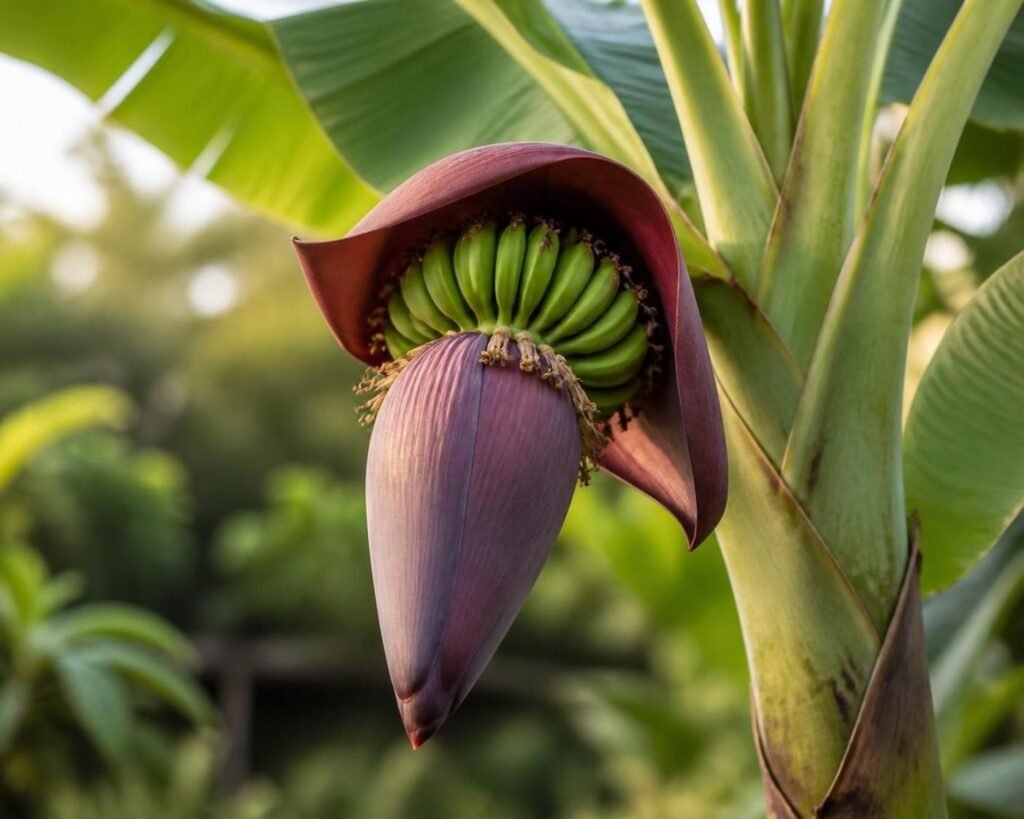
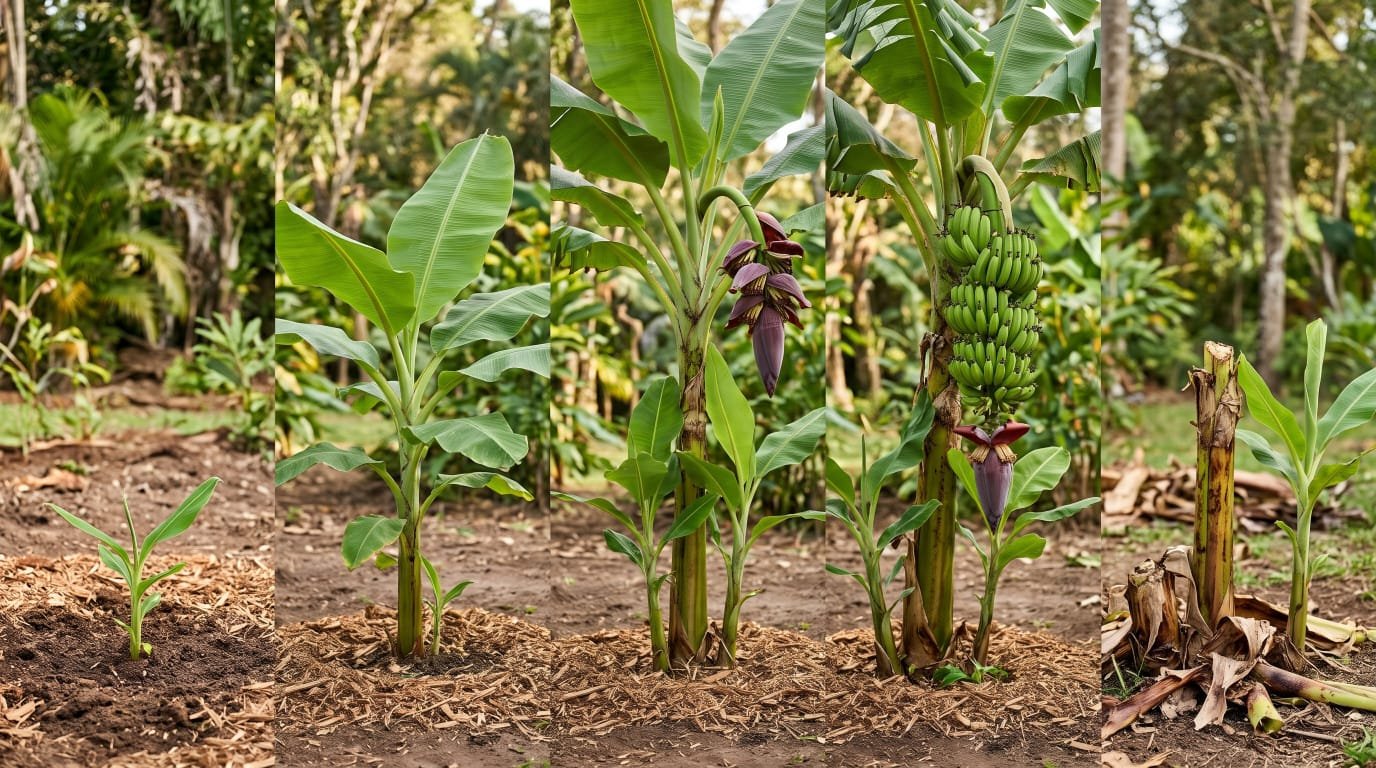
When the plant is ready, the flower stalk rises up through the middle of the pseudostem. It comes out at the top as a hanging bud wrapped in reddish-purple bracts. The bracts roll back to show a hand of tiny fruits, usually one to three hands a day. The first flowers are female and swell into bananas without pollination, which is why edible types are seedless. Our guide to when banana trees flower and produce fruit shows what each stage of the bud looks like. If the stalk stays trapped inside the pseudostem instead, that is the choking described above, and cold or severe drought is the first suspect.
A plant that is fourteen months old, with no flower but healthy new leaves, is not late. The range runs to 15 months before flowering, and some varieties take much longer to harvest, as the table showed. None of the sources above gives a hard month at which a banana counts as overdue. If a plant in a warm spot is still not flowering at two years, ask “what changed?” instead of “how long?”
Why Is My Banana Tree Taking So Long to Fruit?
The usual reflex is a bag of fertilizer. Hold off. Feeding fixes only one cause on this list, and several of the others are quicker to check.
Start with what you planted. Dig out the tag or the receipt. An ornamental species or a seedy type sold for its foliage may never give a worthwhile bunch of eating bananas, however long you wait.
Then look back at the weather. A cold spell in the middle of the growing season costs more than the days it lasts, because leaf production stalls. If your tagged leaf stopped moving through a cool month, you have your answer, and there is nothing to treat. Growth picks up again when the nights warm.
Then work through the things you can change. The extension sources are clearest on these:
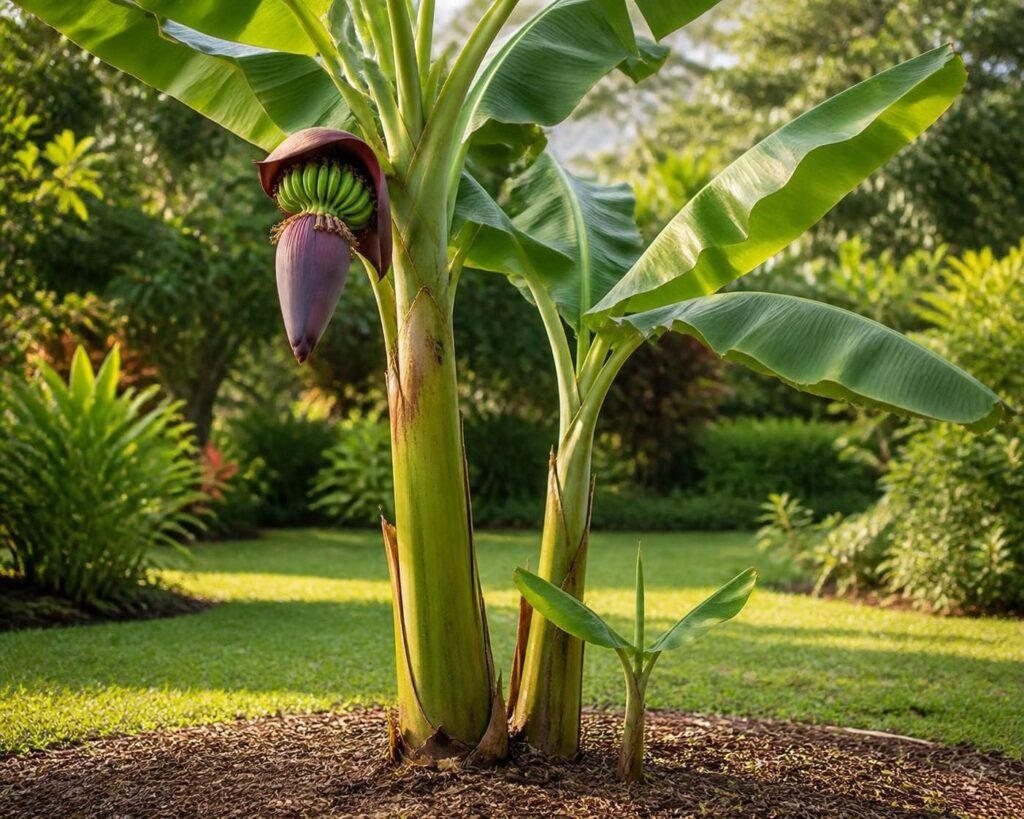
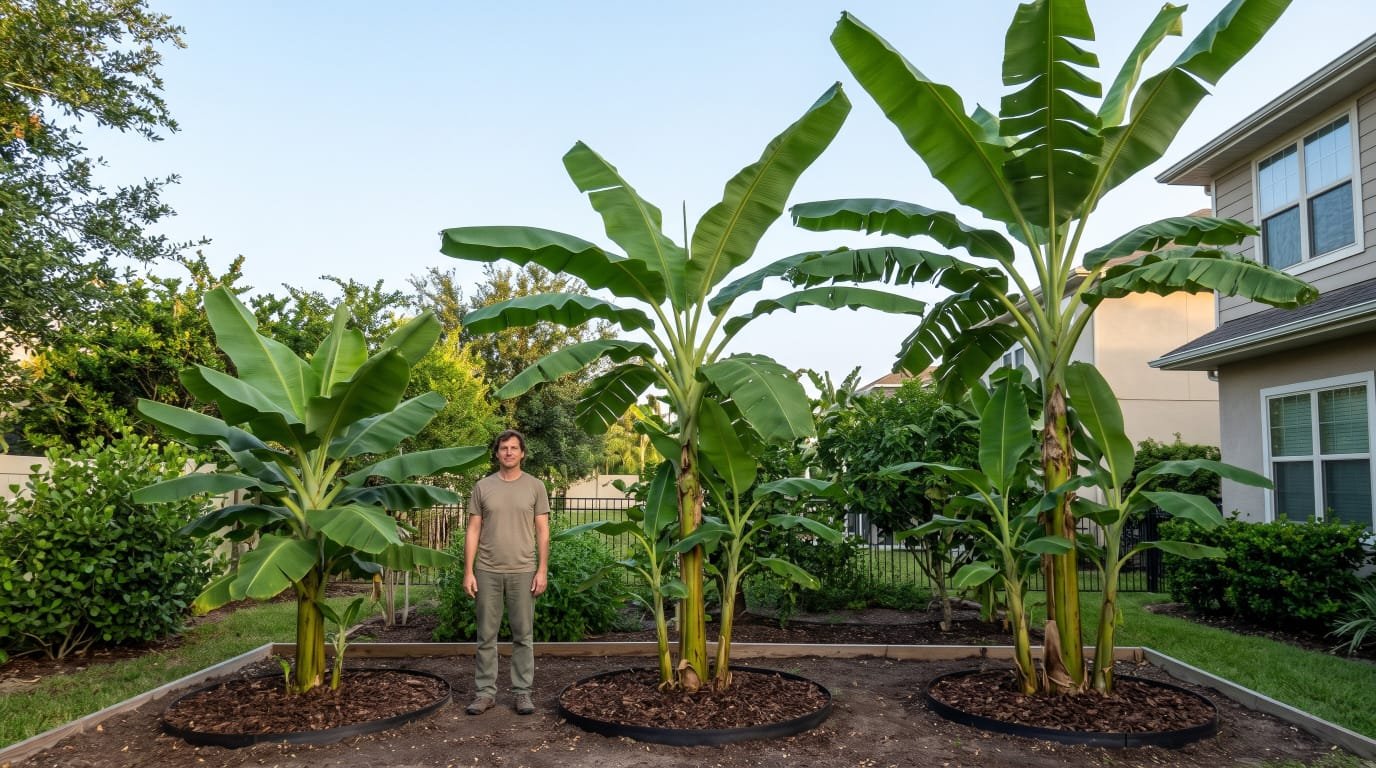
- Crowding. Every extra stem competes for water, light and food, and that competition prolongs the time to flower and harvest. Aim for three or four stems of different ages: one fruiting or about to, one at roughly half to two-thirds of its size, and one or two small suckers. Remove the rest at ground level.
- Shade. Bananas tolerate shade up to about half, but shade delays growth and fruit development. Full or near-full sun is best.
- Thirst. Drought at any stage lengthens the time to flowering and fruiting and shrinks the bunch. The guide figure is roughly an inch to an inch and a half of water a week when rain is missing. Soggy soil stalls a plant just as surely, so push a finger into the root zone before watering, and see our banana tree soil guide if water lingers.
- Early feeding. The first three to four months of growth set the weight of the bunch and the number of hands. A hungry young plant pays for it later. Use a high-potassium banana feed and follow the product label; our banana tree fertilizer guide covers what to look for. Check local regulations too, since approved products differ by region.
- Mulch. In the Uganda trial mentioned earlier, mulched plants flowered earlier in every crop cycle. Our mulch for banana trees guide covers materials and spacing.
- The male bud. Once the last viable hand has formed, snip the purple male bud off a few inches below it. Extension guidance is that removing it promptly speeds fruit development, and that leaving it on gains you nothing.
One caution. If a warm, sunny, watered and thinned plant is still not moving, the problem may be underground: nematodes chewing the roots, or a wilt disease such as Panama disease. Squeeze the base of the pseudostem and dig gently at the root zone. Soft tissue, a foul smell or a mass of dead roots means it is time to call your local extension office, not to guess.
When to Harvest Bananas: Pick by the Fruit, Not the Calendar
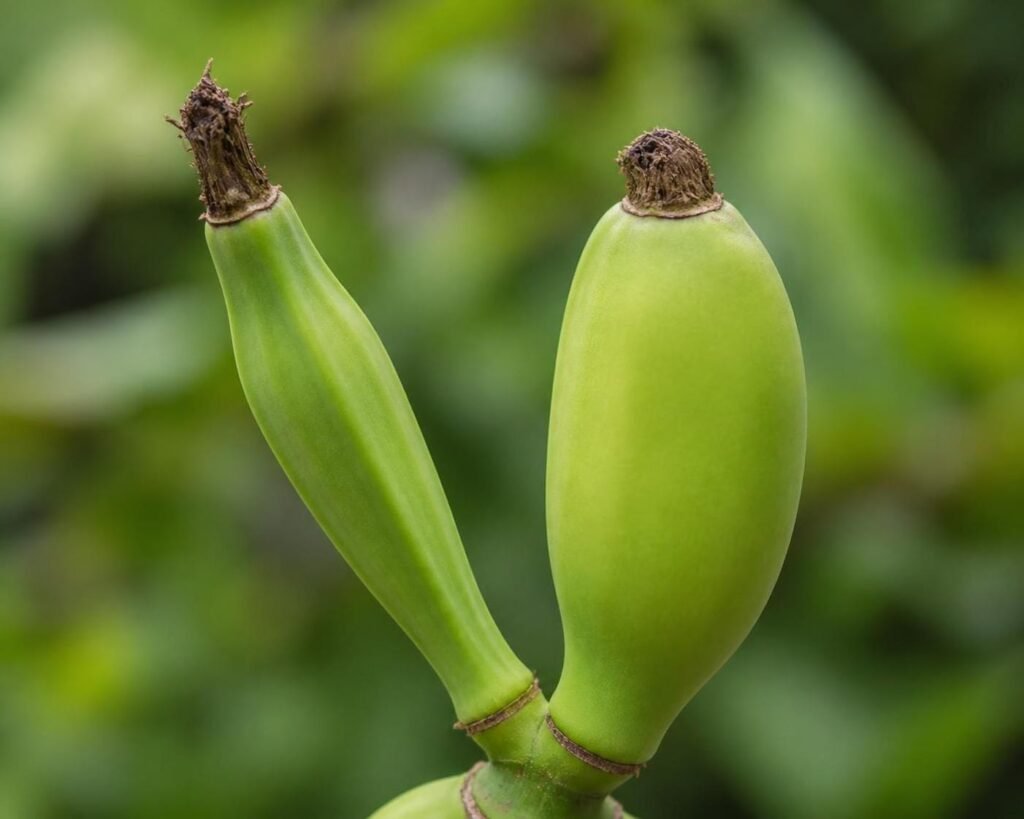
Counting days from the flower gets you to the right month. The fruit tells you the day. The usual advice is to cut the whole stem when the individual bananas are plump and rounded. They will still be green, but they are mature and ripen to good quality off the plant. The sharp angles on the sides of the fingers have swelled out and smoothed over; an immature bunch still looks thin and angular.
Many growers cut a week or two before the fruit would ripen on the plant. They hang the bunch in a cool, shaded spot, since bananas ripened in the shade tend to taste better than those left on the stem.
What Happens After the First Banana Bunch
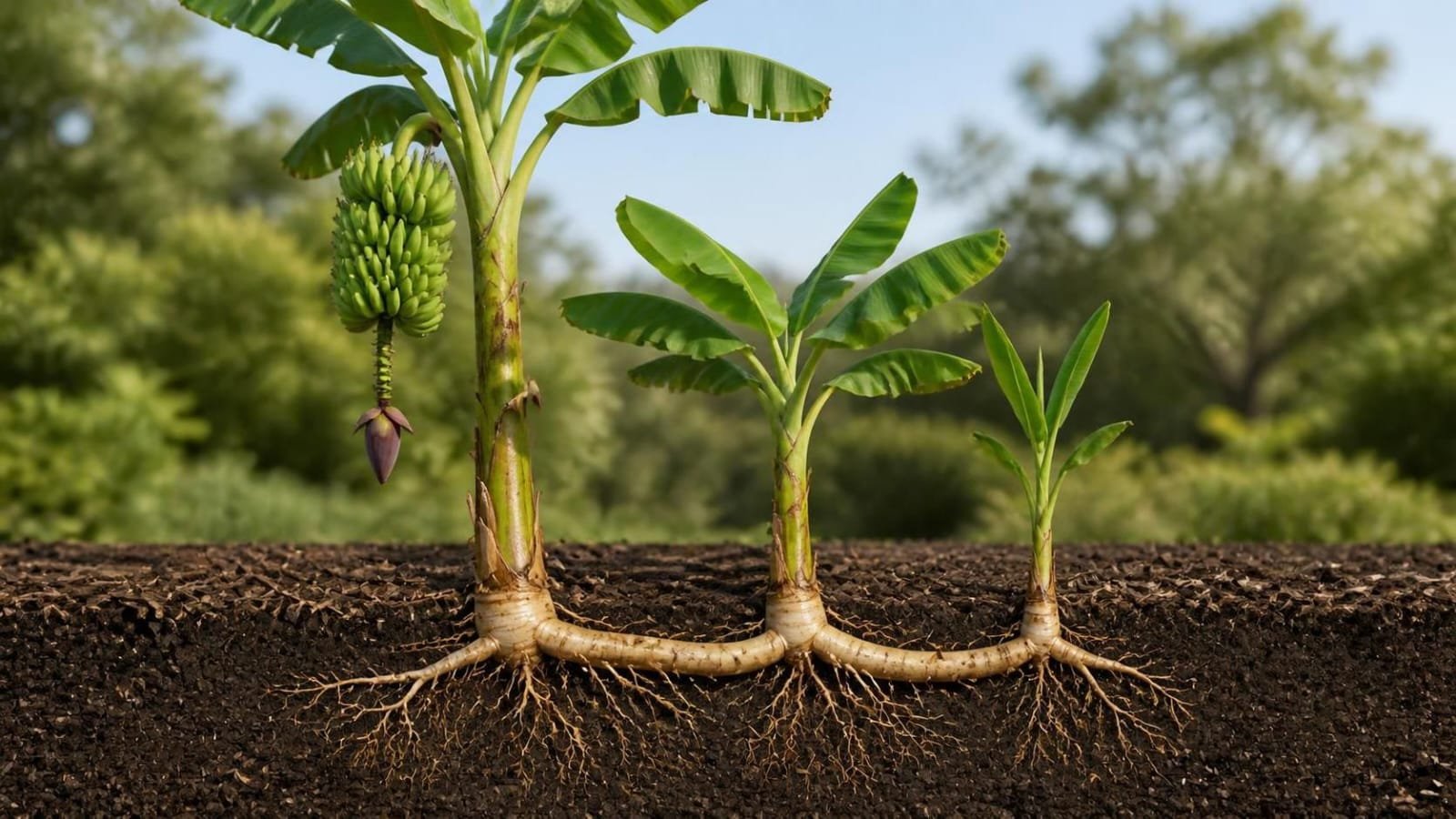
Each stem fruits once. Once the bunch is cut, that stem is finished. The Arkansas extension service says to cut it to the ground so the new stems can develop. Leave a stem that is still filling fruit alone: it is feeding the bunch. The next stem is already growing from the same corm. That is why a banana patch can run for years even though each stem fruits only once. Our article on whether banana trees only fruit once explains the full cycle.
Expect the first crop to be the slowest and the smallest. Every crop after it starts from a root system that is already in the ground.
Quick answers
How long after flowering are bananas ready to harvest?
Between about 80 and 180 days, depending on temperature, variety and care. In steady tropical warmth it is closer to 100 days, and cool weather pushes it toward the long end.
Do banana trees die after fruiting?
The stem that fruited does, and you cut it down. The corm underneath sends up new stems, so the plant itself carries on.
How long does a Dwarf Cavendish take to fruit?
The sources used here give no separate timetable for it. Expect the general 10 to 15 months to flower, plus the fruit-filling period. It may run a little shorter than a tall type, since smaller bananas flower earlier.
Can a banana tree fruit in a pot?
Yes, but it is slower and less likely than in the ground, and indoors you should not count on it. A dwarf variety in a big pot, outdoors for the summer, gives the best chance. The banana tree in a pot guide has the details.
Do bananas grow from seed?
Edible bananas are seedless, so seed is not the route to fruit. They are multiplied from suckers or tissue culture.
Tie a cloth to a leaf today, write the date on the calendar, and look again in a month. That tells you more about your plant than any figure in this article. For watering and feeding while you wait, the banana tree care guide is the next place to go.
4 thoughts on “How Long Does a Banana Tree Take to Grow? 12–18 Months”